Research Article | | Peer-Reviewed

Lead Pollution Level and Human Health Risks Assessment in Topsoil Under Different Land-use in the Korhogo City (Northern Côte d’Ivoire)

Received: 23 March 2026     Accepted: 3 April 2026     Published: 16 April 2026
Views:       Downloads:
Abstract

Rapid urban growth and industrial activities have intensified the presence of toxic elements in urban soils, with lead (Pb) being of particular concern. This study provides the first comprehensive assessment of Pb contamination and associated human health risks in the urban soils of Korhogo, northern Côte d’Ivoire. Twenty surface soil samples (0–5 cm) were collected from four land use categories including residential, public gardens, commercial areas, and peri urban zones and analyzed using inductively coupled plasma atomic emission spectrometry (ICP AES). Pollution levels were evaluated through geochemical indices (contamination factor, CF, and geoaccumulation index, Igeo), while probabilistic risk models quantified potential health impacts. Results show that Pb concentrations follow the order: commercial > public garden > residential > peri urban, with values exceeding WHO/FAO permissible limits. Commercial soils exhibited moderate contamination, whereas other sites showed low levels. Oral ingestion and dermal absorption were identified as the main exposure pathways. Risk assessment indicated no non carcinogenic effects for adults or children, while carcinogenic risks remained within the acceptable range, though more pronounced in children. These findings establish a baseline for sustainable monitoring and management of Pb contamination in urban soils of Korhogo.

Published in World Journal of Applied Chemistry (Volume 11, Issue 1)
DOI 10.11648/j.wjac.20261101.12
Page(s) 14-24
Creative Commons

This is an Open Access article, distributed under the terms of the Creative Commons Attribution 4.0 International License (http://creativecommons.org/licenses/by/4.0/), which permits unrestricted use, distribution and reproduction in any medium or format, provided the original work is properly cited.

Copyright

Copyright © The Author(s), 2026. Published by Science Publishing Group

Keywords

Lead, Urban Soil, Health Risk, Geochemical Indices, Land-use, Korhogo

1. Introduction
Soil contamination by toxic elements is a growing environmental challenge worldwide, largely driven by industrial expansion, agricultural intensification, and rapid urbanization . Lead (Pb) is of particular concern because of its persistence, toxicity, and lack of biological function in humans . Although Pb occurs naturally in the Earth’s crust, anthropogenic activities remain the dominant sources of contamination. These include mining, construction, waste disposal, transportation, and the historical use of Pb-containing fuels and materials . Once deposited in soils, Pb can enter the human body through ingestion, inhalation of dust, or dermal contact, leading to neurological damage, hematopoietic disorders, renal impairment, and developmental deficits in children .
In many developing countries, uncontrolled waste recycling, artisanal mining, and the continued use of Pb-based products exacerbate exposure risks. Documented cases in Senegal, Nigeria, India, and Côte d’Ivoire highlight the severe health impacts of Pb contamination, particularly among children . Even blood Pb levels below 10 µg/dL have been associated with long-term cognitive impairment and reduced school performance . The vulnerability of pregnant women and children further underscores the urgency of monitoring Pb in urban environments .
Korhogo, the largest city in northern Côte d’Ivoire, represents a critical case study. With a population exceeding 740,000 and rapid migration from neighboring countries, the city has undergone significant expansion in commerce, transportation, and agro-industrial activities . Nearby gold mining operations and increasing urbanization raise concerns about Pb contamination in soils . Yet, despite evidence of Pb exposure in other West African contexts , scientific data on urban soils in Korhogo remain scarce.
This study aims to fill that gap by assessing Pb concentrations in soils across four land-use types—residential areas, public gardens, commercial zones, and peri-urban farmland. Using geochemical indices (contamination factor, CF, and geoaccumulation index, Igeo) and probabilistic health risk models, we evaluate both pollution levels and potential non-carcinogenic and carcinogenic risks for adults and children. The findings provide a baseline dataset to guide sustainable monitoring and management of Pb contamination in urban soils of Côte d’Ivoire.
2. Material and Methods
2.1. Study Area and Sampling Sites
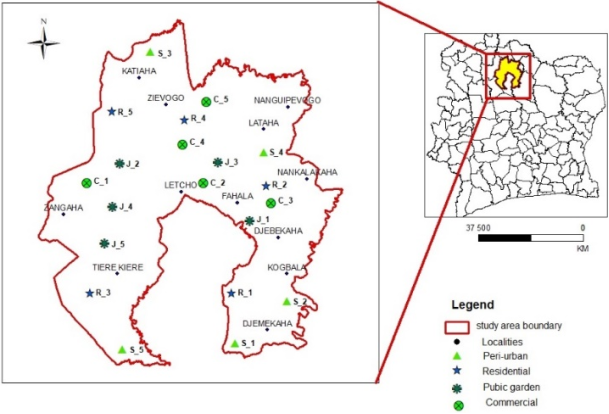
Korhogo (9°28′N; 5°36′W), the largest city in northern Côte d’Ivoire, lies within the Savanes District and Poro region (Figure 1). The city hosts nearly 780,000 inhabitants and is characterized by a semi arid continental climate, with annual rainfall averaging 1243 mm and mean temperatures around 29°C. Geologically, Korhogo belongs to the Birimian greenstone belt, dominated by sedimentary formations and granitoid intrusions . Twenty surface soil samples (0–10 cm) were collected from four land use categories: residential areas (n=5), public gardens (n=5), commercial zones (n=5), and peri urban farmland (n=5). Each composite sample consisted of five subsamples taken at 1 m intervals to account for spatial variability.
Figure 1. Study area location and sampling points.
2.2. Sample Pretreatment and Chemical Analysis
In the laboratory, samples were air dried, sieved (<63 µm), and cleared of stones and organic debris. Soil pH was measured in a 1: 2.5 soil water suspension using a HANNA 81I pH meter. Grain size distribution was determined following ASTM D422 63 . Total organic carbon (TOC) was estimated by loss on ignition (LOI) method. For Pb determination, samples were digested using HNO₃–HClO₄–HF protocol , and concentrations were measured by inductively coupled plasma atomic emission spectrometry (ICP AES, iCAP 6200, Thermo Fisher).
2.3. Pollution Indices
Lead contamination was assessed using the geoaccumulation index (Igeo) (Müller, 1969) and contamination factor (CF) . Both indices compare measured Pb concentrations (CPb) with background values (Bn), here taken as the average upper continental crust (UCC) concentration of 20 mg/kg . Classification of contamination levels followed standard categories . The Igeo and CF values were evaluated through equations (1) and (2), respectively:
Igeo=log2CPb1.5Bn(1)
CF=CPbBn(2)
In these expressions, CPbdenotes the concentration of lead measured in the soil sample, while Bncorresponds to the natural background concentration of Pb. The factor 1.5 is introduced to compensate for possible natural fluctuations in background levels. Both BPband CPb(reference)refer to the geochemical baseline values of lead. In the present study, the background concentration of Pb was taken as the average value of the upper continental crust (UCC) reported by Taylor and McLennan . The categories of contamination based on the Igeo and CF indices are summarized in Table 1.
Table 1. Classification of Igeo and CF values.

Class

Igeo values

Status

CF values

Status

0

< 0

Unpolluted

CF < 1

Low contamination

1

0 < Igeo < 1

Unpolluted to moderately polluted

1 CF < 3

Moderate contamination

2

1 < Igeo < 2

Moderately polluted

3 CF < 6

Considerable contamination

3

2 < Igeo < 3

Moderately to strongly polluted

CF > 6

Very high contamination

4

3 < Igeo < 4

Strongly polluted

5

4 < Igeo < 5

Strongly to extremely polluted

6

Igeo > 5

Extremely polluted

2.4. Human Health Risk Assessment
Lead (Pb) contamination in soils is known to negatively influence microbial communities, and at high concentrations, Pb can leach into groundwater, thereby increasing potential risks to human health . In this work, the potential health risks associated with Pb exposure for both children and adults were evaluated by estimating the average daily intake via ingestion (ADIing) following established guidelines , as expressed in equation (3).
ADIing=CPb×SIR×EF×EDBW×AT×10-6(3)
Here, ADIing (mg/kg/day) represents the estimated daily intake of Pb through ingestion. CPbis the Pb concentration in soil (mg/kg), while SIR denotes the soil ingestion rate (200 mg/day for children and 100 mg/day for adults). EF corresponds to the exposure frequency (365 days/year), and ED is the exposure duration (6 years for children and 62.6 years for adults). BW is the body weight, and AT refers to the averaging time, taken as 2,190 days for children and 22,849 days for adults.
Dermal exposure to Pb was assessed by calculating the average daily intake through skin contact (ADIderm) using equation (4):
ADIderm=CPb×SAF×AF×ABS×EF×EDBW×AT×10-6(4)
In this equation, SAF represents the exposed skin surface area (2,100 cm2 for children and 5,800 cm2 for adults), AF is the soil adherence factor (0.2 kg/m2/day for children and 0.07 kg/m2/day for adults), and ABS is the dermal absorption fraction for Pb (0.031 for both groups).
Inhalation exposure was also considered by estimating the average daily intake via air (ADIinh) using equation (5):
ADIinh=CPb×InR×EF×EDPEF×BW×AT×10-6(5)
Where InR is the inhalation rate (10 m3/day for children and 20 m3/day for adults), and PEF denotes the particle emission factor (1.30×10⁹ m3/kg for children and 3.22×10⁹ m3/kg for adults).
The exposure parameters related to ingestion, dermal contact, and inhalation were adopted from guidelines provided by the South African Department of Environmental Affairs , while life expectancy data were obtained from the Ivorian National Statistics Agency .
2.5. Risk Characterization
Non-carcinogenic and carcinogenic risks associated with Pb exposure were evaluated using the hazard quotient (HQ) and cancer risk (CR), respectively. The HQ is defined as the ratio between the estimated average daily intake (ADI) and the corresponding reference dose (RfD), while CR represents the probability of an individual developing cancer over a lifetime. The carcinogenic risk was calculated by multiplying the ADI by the cancer slope factor (CSF) . The HQ and CR for ingestion, inhalation, and dermal exposure pathways were determined using equations (6) and (7), following standard guidelines :
HQi=ADIi/RfDi(6)
CRi=ADIi×CSFi(7)
For Pb, the RfD values used in this study were 3.5×10⁻3, 3.2×10⁻3, and 7.0×10⁻4 mg/kg/day for ingestion, inhalation, and dermal contact, respectively. The corresponding CSF values were 8.5×10⁻3, 4.2×10⁻2, and 4.2×10⁻1 for the same exposure routes.
The overall non-carcinogenic and carcinogenic risks were further assessed using the hazard index (HI) and total cancer risk (TCR), which integrate contributions from all exposure pathways. These indices were calculated as follows:
HI =HQing+HQinh+HQderm(8)
TCR =CRing+CRinh+CRderm(9)
An HI value greater than 1 indicates the possibility of adverse non-carcinogenic effects, whereas values below 1 suggest negligible risk. Regarding carcinogenic risk, TCR values below 10⁻6 are considered insignificant, values between 10⁻6 and 10⁻4 indicate an acceptable risk range, and values exceeding 10⁻4 reflect a high level of concern .
2.6. Statistical Analysis
One-way analysis of variance (ANOVA) was applied to assess differences in Pb concentrations across the various land-use categories. To identify statistically significant differences between group means, Tukey’s post hoc test was conducted at a 95% confidence level (p < 0.05).
2.7. Quality Assurance and Quality Control
Quality control was ensured through the use of a certified reference material (CRM CNS301-01-050, lot 002462, Sigma-Aldrich). The recovery rates for the analyzed metals ranged from 83% to 108%, confirming acceptable analytical accuracy. In addition, procedural blanks were analyzed in triplicate for every batch of ten soil samples to monitor potential contamination. The method detection limit (LOD) and limit of quantification (LOQ) were determined to be 0.09 µg L⁻1 and 0.8 µg L⁻1, respectively.
3. Results and Discussion
The physicochemical characteristics of the 20 soil samples analyzed in this study are summarized in Table 2. Soil pH values ranged from 4.64 to 7.54, indicating slightly acidic to neutral conditions.
Table 2. Physicochemical parameters of urban soils from three land use types in Korhogo city.

pH

Granulometry (%)

TOC (%)

Fine fraction (silt+clay)

Coarse fraction (sand)

min-max

4.64 – 7.54

13.2 – 40.4

59.60 – 86.6

6.11 – 12.2

mean± SD

5.6 ±0.84

25.9 ±6.80

74.1±5.11

9.25±1.68

median

5.58

25.5

74.3

8.96

CV (%)

15

26.2

6,01

18,1

The proportion of fine particles (silt + clay) varied between 13.2% and 40.4%, while sand content ranged from 59.6% to 86.6%, confirming the predominantly sandy texture of the soils. Total organic carbon (TOC) content ranged from 6.11% to 12.2%. Overall, moderate variability was observed among the measured parameters (coefficient of variation: 6–26.2%) across the different land-use types, although one-way ANOVA indicated no statistically significant differences (p > 0.05). The relatively low mean pH (5.6 ± 0.84) suggests conditions that may enhance the mobility and bioavailability of metal(loid)s in soil, thereby facilitating their uptake by plants. In addition, the comparatively low TOC content (9.25 ± 1.68%) is indicative of reduced organic matter inputs and limited microbial activity, which are typical features of urban soils. Similar physicochemical characteristics have been reported for urban soils in Ouagadougou, Burkina Faso .
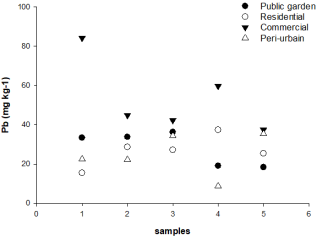
Lead (Pb) concentrations across the four land-use types (public gardens, residential, commercial, and peri-urban areas) are presented in Figure 2. Pb levels ranged from 18.2 to 36.3 mg kg⁻1 in public gardens, 15.2 to 37.4 mg kg⁻1 in residential areas, 37.5 to 84.4 mg kg⁻1 in commercial zones, and 8.8 to 35.4 mg kg⁻1 in peri-urban soils. The mean Pb concentrations (mg kg⁻1) followed the order: commercial (53.7 ± 16.9) > public garden (28.2 ± 7.78) > residential (26.8 ± 7.02) > peri-urban (24.7 ± 9.72). On average, Pb concentrations in all land-use types exceeded the upper continental crust (UCC) background value (20 mg kg⁻1) by approximately 1.5 to 2 times. The highest concentration (84.4 mg kg⁻1), recorded in commercial areas, surpassed the recommended limit of 50 mg kg⁻1 established by WHO/FAO . Statistical analysis confirmed that Pb levels in commercial sites were significantly higher (p < 0.05) than those in the other land-use categories. The elevated Pb concentrations are likely linked to anthropogenic inputs, particularly traffic-related emissions and intensive human activities. Despite the widespread use of unleaded gasoline, vehicular emissions remain a relevant source of Pb in urban environments . Additionally, agricultural practices—such as the application of fertilizers and pesticides—may contribute to Pb accumulation in urban soils. For instance, Tape-Ojong et al. reported that over 40% of privately managed farms rely heavily on agrochemical inputs.
Figure 2. Pb concentrations of urban soils from different land-use types in Korhogo city.
Comparison with other West African studies
To contextualize the contamination levels observed, Pb concentrations from this study were compared with those reported in other African regions (Table 3). The mean Pb levels in northern Côte d’Ivoire were lower than those documented in Nigeria , but generally comparable or lower than values reported in Ghana , Burkina Faso , Cameroon , and South Africa . These variations reflect differences in urbanization intensity, industrial activities, and local environmental conditions.
Table 3. Comparison of Pb concentrations in urban soil in this study with others African Cities.

City (Country)

Pb concentration (mg kg-1)

References

Range

Mean ± SD

Korhogo (Côte d’Ivoire)

8.80 – 84.2

33.3±0.03

This study

Ajao (Nigeria)

0 – 0.054

0.005

Yaoudé (Cameroon)

9.9 - 140

43.5 ±40.9

Ouagadougou (Burkina Faso)

1020 - 19162

8900 ±7784

Tarkwa (Ghana)

0.851 -1707

57.9±200

Tarkwa (Ghana)

2.05 - 284

106±84.5

Pretoria (South Africa)

-

188±3.98

Single Pollution Indices (Igeo and CF)
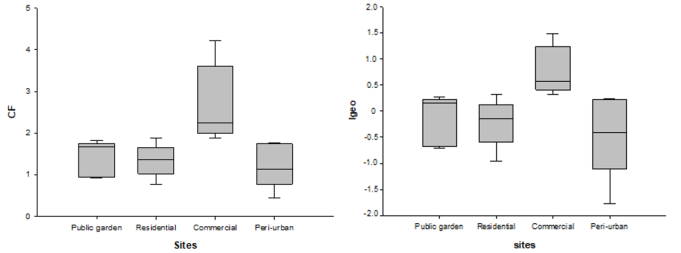
The geoaccumulation index (Igeo) and contamination factor (CF) were used to evaluate the extent of Pb contamination relative to background levels (Figure 3). Igeo values ranged from −0.71 to 1.49, while CF values varied between 0.44 and 4.21. More than 50% and 75% of the samples exhibited Igeo values between 0 and 1 and CF values between 1 and 3, respectively, indicating unpolluted to moderately polluted conditions.
The highest contamination levels were observed in commercial areas (Igeo = 1.48; CF = 4.21), reflecting moderate pollution. This is consistent with the nature of these zones, which are typically characterized by intense human activities such as transportation hubs, fuel stations, and vehicle repair workshops. However, the interpretation of these indices should consider both the selected background values and the geological context of the study area. Previous studies have reported similar moderate contamination levels in Pretoria (South Africa) , whereas more severe contamination has been documented in Ouagadougou . The relatively elevated metal levels in Korhogo may also be influenced by historical mining activities in the region . It is important to note that Pb has no known biological function and is associated with severe health effects, including damage to the nervous, hematopoietic, hepatic, and renal systems .
Figure 3. CF and Igeo indices of urban soil from Korhogo city.
Human Health Risk Assessment
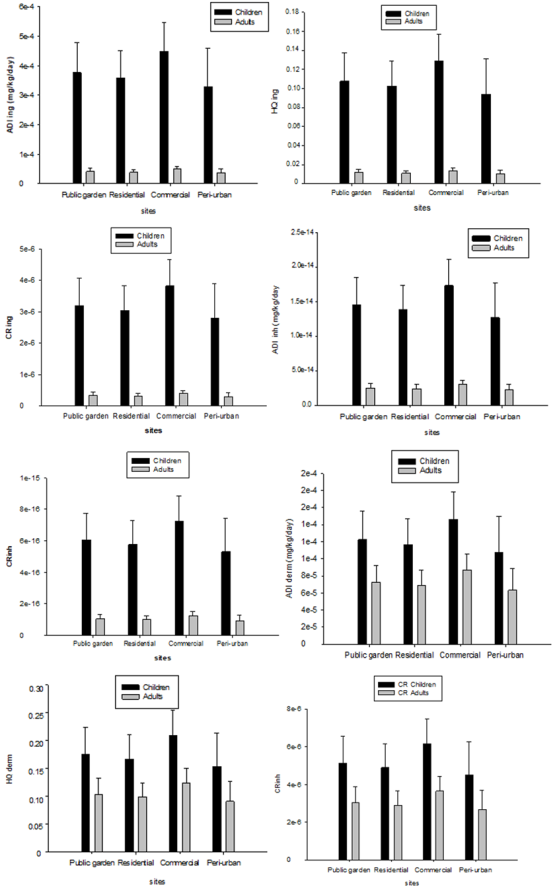
The estimated average daily intake (ADI) of Pb for children and adults via ingestion, dermal contact, and inhalation is illustrated in Figure 4. ADI values ranged from 1.4×10⁻14 to 4.50×10⁻4 mg/kg/day for children and from 2.19×10⁻15 to 8.66×10⁻5 mg/kg/day for adults. The relative contribution of exposure pathways differed slightly between groups: ingestion > dermal > inhalation for children, and dermal > ingestion > inhalation for adults. These findings highlight ingestion and dermal contact as the dominant exposure routes, consistent with previous studies conducted in Nigeria and Burkina Faso .
Figure 4. Average daily intake (ADI), hazard quotients (HQ), and non-carcinogen (HI) risk indices of children and adults’ exposure to lead through ingestion (ing), inhalation (inh), and dermal absorption (derm).
The hazard quotient (HQ) values ranged from 3.95×10⁻12 to 2.09×10⁻1 for children and from 6.84×10⁻13 to 1.24×10⁻1 for adults. In all cases, HQ values were below 1, indicating no significant non-carcinogenic risk associated with Pb exposure in the studied areas. The highest HQ values were recorded in commercial zones.
Carcinogenic risk (CR) values ranged from 2.79×10⁻6 to 6.14×10⁻6 for children and from 2.99×10⁻⁷ to 3.64×10⁻6 for adults, falling within the acceptable risk range. Notably, children exhibited higher CR values than adults, reflecting their greater vulnerability to environmental contaminants.
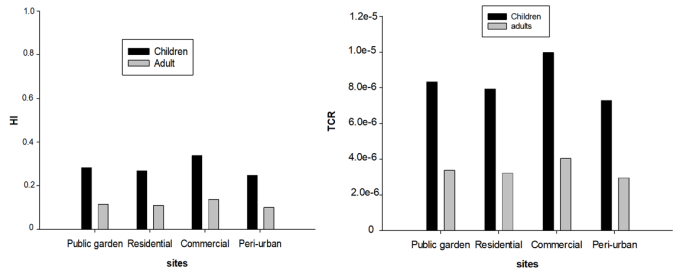
The total risk indices, hazard index (HI) and total carcinogenic risk (TCR), ranged from 0.10 to 0.33 and from 9.19×10⁻1⁷ to 6.14×10⁻6, respectively (Figure 5). Since HI values remained below 1 and TCR values were within acceptable limits, the results suggest that Pb exposure from urban soils in Korhogo does not pose significant health risks to the population. Nevertheless, ingestion and dermal contact were identified as the primary contributors to overall risk. In contrast, higher non-carcinogenic risks have been reported in Pb-contaminated playground soils in Ghana .
Figure 5. Non-carcinogenic (HI) and total carcinogenic risk (TCR) indices.
4. Conclusion
This study investigated Pb contamination in urban topsoils from different land-use types in Korhogo City, with the aim of assessing its distribution, pollution status, and associated human health risks. A total of 20 soil samples were analyzed using inductively coupled plasma atomic emission spectrometry (ICP-AES). Pollution indices (Igeo and CF), along with health risk indicators (HQ, HI, CR, and TCR), were applied to evaluate contamination levels and potential impacts. The results revealed that Pb concentrations followed the order: commercial > public garden > residential > peri-urban. Overall, Pb levels in urban soils exceeded the natural background value of the upper continental crust (20 mg kg⁻1), indicating anthropogenic enrichment. Moderate contamination was observed in commercial areas based on Igeo (0.77 ± 0.44) and CF (2.88 ± 0.85) values, while other land-use types showed low to moderate contamination. Although the calculated non-carcinogenic risk indices (HQ and HI) indicate no immediate health concern for both adults and children, the carcinogenic risk remains within the acceptable range, with slightly higher susceptibility observed in children. These findings highlight the need for continuous monitoring and management of urban soil quality, particularly in areas with intense human activity.
Abbreviations

CPb

Pb Concentration

Igeo

Geoaccumulation Factor

CF

Contamination Factor

ADIing

Average Daily Ingestion Through Oral Ingestion

ADIinh

Average Daily Ingestion Through Inhalation

ADIderm

Average Daily Ingestion Through Dermal Absorption

IR

Ingestion Rate

SIR

Soil Ingestion Rate

EF

Exposure Frequency

UCC

Upper Continental Crust

AT

Average Time

SAF

Skin Surface Area

AF

Adherence Factor

HQ

Hazard Quotient

HI

Hazard Index

CR

Carcinogenic Risk

TCR

Total Carcinogenic Risk

ED

Exposure Duration

BW

Body Weight

Acknowledgments
The authors sincerely acknowledge the support of the management and technical staff of the Centre de Recherche Océanographique (CRO), Vridi, Côte d’Ivoire, for their assistance with the chemical analyses.
Author Contributions
Kakou Charles Kinimo: Conceptualization, Investigation, Methodology, Data curation, Writing – original draft, writing – review & editing
Donafolgui Yeo: Methodology, Data curation, Writing-original draft
Tano Patrice Fato: Methodology, Data curation
Koffi Pierre Dit Adama Ngoran: Formal Analysis, Writing – review & editing
Krougba Yves Nangah: Formal Analysis, Supervision
Bi Irie Herve Goure Doubi: Writing – review & editing
Data Availability Statement
Data will be made available on request.
Conflicts of Interest
The authors declare that they have no competing interests.
References
[1] Akhtar M., Zhao, Y., Gao, G., Gulzar, Q., & Hussain, A. 2022. Assessment of spatiotemporal variations of ecosystem service values and hotspots in a dryland: A case‐study in Pakistan. Land Degradation & Development, 33(9), 1383-1397,
[2] Li, F. J., Yang, H. W., Ayyamperumal, R., Liu, Y. 2022. Pollution, sources, and human health risk assessment of heavy metals in urban areas around industrialization and urbanization-Northwest China. Chemosphere, 308, 136396,
[3] Mandal, G. C., Mandal, A., Chakraborty, A. 2022. The toxic effect of lead on human health: A review. Human Biology and Public Health, 3,
[4] Assi, M. A., Hezmee, M. N. M., Sabri, M. Y. M., Rajion, M. A. 2016. The detrimental effects of lead on human and animal health. Veterinary world, 9(6), 660,
[5] Angrand, R. C., Collins, G., Landrigan, P. J., & Thomas, V. M. 2022. Relation of blood lead levels and lead in gasoline: an updated systematic review. Environmental Health, 21(1), 138,
[6] Wu, Y. F., Li, X., Yu, L., Wang, T. Q., Wang, J. N., Liu, T. T., 2022. Review of soil heavy metal pollution in China: spatial distribution, primary sources, and remediation alternatives, Resources. Conserv. Recycl. 181, 106261
[7] Bini, C., & Wahsha, M. 2014. Potentially harmful elements and human health. In PHEs, Environment and Human Health: Potentially harmful elements in the environment and the impact on human health (pp. 401-463). Dordrecht: Springer Netherlands,
[8] Maria, H., Jessica, A., Gabriella, E., Aprillia, C., Yudiarso, A. 2025. The Impact of Lead (Pb) on Health. Journal of Global Research in Public Health, 10(1), 1-14,
[9] Hu, H., Zeng, X., Dai, C., Xie, B., Zhang, J., Xu, X., Huo, X. 2024. A Decade-Long Comparison of Heavy Metal (loid) s in the River and Children’s Health Risk Assessment of an E-Waste Recycling Area. Water, 16(22), 3226,
[10] Collin, M. S., Venkatraman, S. K., Vijayakumar, N., Kanimozhi, V., Arbaaz, S. M., Stacey, R. S., Anusha J., Choudhary R., Lvov V., Tovar G. I., Senatov F., Kappala S., Swamiappan, S. 2022. Bioaccumulation of lead (Pb) and its effects on human: A review. Journal of Hazardous Materials Advances, 7, 100094,
[11] Gille, V., Gubert, F., Saint-Macary, C., Dos Santos, S., Houffoue, F., Kouadio, H., Marahoua E., Soro P., Van Geen, A. 2025. Lead Risks and Prevention: Evidence from Ivory Coast. UMR LED, 20 p.
[12] Kouassi, D. N. G. F., Yapi, A. E., Kouassi, N. G. L. B., Yao, K. M., Coulibaly, A. S. 2025. Distribution and human health risk assessment of cadmium, arsenic, mercury, lead, and iron in settling particles from the transboundary estuary in three rivers of Côte d’Ivoire, West Africa. Acta Geochimica, 1-19,
[13] Das, R. 2022. Sources of lead (Pb) in atmosphere over Indian cities and health impacts. In Asian atmospheric pollution (pp. 435-452). Elsevier,
[14] Mielke, H., & Egendorf, S. 2023. Getting the lead out: a career-long perspective on leaded gasoline, dust, soil, and proactive pediatric exposure prevention. Medical Research Archives, 11(5),
[15] Vukelić D., Djordjevic A. B., Anđelković M., Repić A., Baralić K., Ćurčić M., Dukić-Ćosić D., Boričić N., Antonijević B., Bulat Z. 2023. Derivation of benchmark doses for male reproductive toxicity in a subacute low-level Pb exposure model in rats. Toxicology Letters, 375, 69-76,
[16] Pesce, G., Sesé, L., Calciano, L., Travert, B., Dessimond, B., Maesano, C. N., Ferrante G., Huel G, Prud’homme J., Guinot M., Soomro M. H., Baloch R., Lhote R., Annesi‐Maesano, I. 2020. Foetal exposure to heavy metals and risk of atopic diseases in early childhood. Pediatric Allergy and Immunology, 32(2), 242-250,
[17] RGPH, 2021. General Population and Housing Census: Final overall results.
[18] N’goran, K. P. D. A., Kouassi, N. G. L. B., Diabate, D., Ouattara, A. A., Kinimo, K. C., Yao, K. M., & Trokourey, A. 2022. Pollution and Ecological Risk Assessment of Traces Metals in the Sediments of Gold Mining in Savanna District (Korhogo and Tengrela), Côte d'Ivoire. Science Journal of Chemistry, 10(3),
[19] Sylla, G., Coulibaly, T. J. H., Coulibaly, N., Kouadio, K. C. A., Coulibaly, H. S. J. P., Cissé, S., N’guessan, K. H. J. 2023. Urban expansion of Korhogo City (Côte d’Ivoire) using gis and nocturnal remote sensing. Computational Urban Science, 3(1), 23,
[20] Sako, A., Coulibaly, K., Yé, L. 2023. Environmental geochemistry and human health risk assessment of potentially toxic elements in urban soils in the vicinity of a Pb fire-assay laboratory in Ouagadougou, Burkina Faso. Water, Air, & Soil Pollution, 234(11), 712,
[21] Egbueri, J. C., Ukah, B. U., Ubido, O. E., Unigwe, C. O. 2022. A chemometric approach to source apportionment, ecological and health risk assessment of heavy metals in industrial soils from southwestern Nigeria. International Journal of Environmental Analytical Chemistry, 102(14), 3399-3417,
[22] Yao, A. N., Kouamelan, A. N., Houssou, G. N., Mondah, O. R., Gballou, C. B., Coulibaly, Y. 2025. Petrography and Geochemistry of Manganese Protores from Laniokaha (Korhogo, Northern Côte d’Ivoire). Open Journal of Geology, 15(3), 142-154,
[23] ASTM, 2017. Standard Test Method for Particle-Size Analysis of Soils. ASTM International: West Conshohocken, PA, USA, 2017, ASTM D422-63.
[24] Chen Z., Yipeng L., Mengyang Y., Zhou H., Wu D., Renqi D., Xinling D., Zhihong L. 2023. Using Inverse Distance Weighting and Pb Isotopic Compositions Reveal Source Contribution and Transfer Mechanism of Pb in Soil-Wheat System: A Case Study of Suburban Farmland. Available at SSRN:
[25] Tomlinson, D. L., Wilson, J. G., Harris, C. R., Jeffrey, D. W., 1980. Problems in the assessment of heavy metals levels in estuaries and the formation of pollution index. Helgol. Minehunters. 33 (1–4), 566–575,
[26] Taylor S. R. & McLennan S. M. 1995. The geochemical evolution of the continental crust, Reviews of Geophysics, é: 241-265,
[27] Shetty, B. R., Pai, B. J., Salmataj, S. A., Naik, N. 2024. Assessment of Carcinogenic and non-carcinogenic risk indices of heavy metal exposure in different age groups using Monte Carlo Simulation Approach. Scientific reports, 14(1), 30319,
[28] Obeng-Gyasi, E. 2022. Sources of lead exposure in West Africa. Sci, 4(3), 33,
[29] USEPA, 2017. Human health risk assessment for the smurfit?stone/frenchtown mill operable unit 1 site located in Mis?soula County, Montana. Washington, DC: U.S. Environmental Protection Agency.
[30] DEA. 2010. Framework for the management of contami?nated land (p. 74p). Republic of South Africa.
[31] ANSAT 2025. Agence national de la statistique,
[32] Afolabi O. O., Wali, E., Asomaku, S. O., Ogbuehi, N. C., Bosco-Abiahu, L. C., Orji, M. C., Emelu, V. O. 2023. Ecotoxicological and health risk assessment of toxic metals and metalloids burdened soil due to anthropogenic influence. Environmental Chemistry and Ecotoxicology, 5, 29-38,
[33] USEPA 1989. Risk Assessment Guidance for Superfund. Human Health Evaluation Manual (Part A). Vol. I (EPA/540/1-89/002).
[34] USEPA, 2002. Supplemental guidance for developing soil screening levels for superfund sites. USEPA.
[35] WHO/FAO, 2001. Codex alimentarius commission. Food additives and contaminants. Joint FAO/WHO Food Standards Programme, ALINORM 10/12A.
[36] Ye, J., Li, J., Wang, P., Ning, Y., Liu, J., Yu, Q., Bi, X. 2022. Inputs and sources of Pb and other metals in urban area in the post leaded gasoline era. Environmental Pollution, 306, 119389,
[37] Tabe-Ojong, P. Jr, M., Nyam, Y. S., Lokossou, J. C., Gebrekidan, B. H. 2023. Farmer advisory systems and pesticide use in legume-based systems in West Africa. Science of the Total Environment, 867, 161282,
[38] Kyene, M. O., Gbeddy, G., Mensah, T., Acheampong, C., Kumi-Amoah, G., Ketemepi, H. K., Darko, D. A. 2023. Bioaccessibility and children health risk assessment of soil-laden heavy metals from school playground and public parks in Accra, Ghana. Environmental Monitoring and Assessment, 195(10), 1199,
[39] Osei, L. B., Fosu, S., Ndur, S. A., & Nyarko, S. Y. 2022. Assessing heavy metal contamination and ecological risk of urban topsoils in Tarkwa, Ghana. Environmental monitoring and assessment, 194(10), 710,
[40] Aboubakar, A., Douaik, A., Mewouo, Y. C. M., Madong, R. C. B. A., Dahchour, A., & El Hajjaji, S. 2021. Determination of background values and assessment of pollution and ecological risk of heavy metals in urban agricultural soils of Yaoundé, Cameroon. Journal of Soils and Sediments, 21(3), 1437-1454,
[41] Olowoyo, J. O., Lion, N., Unathi, T., & Oladeji, O. M. 2022. Concentrations of Pb and other associated elements in soil dust 15 years after the introduction of unleaded fuel and the human health implications in Pretoria, South Africa. International Journal of Environmental Research and Public Health, 19(16), 10238,
[42] Flora, G., Gupta, D., Tiwari, A. 2012. Toxicity of lead: a review with recent updates. Interdisciplinary toxicology, 5(2), 47,
Cite This Article
  • APA Style

    Kinimo, K. C., Yeo, D., Fato, T. P., Ngoran, K. P. D. A., Nangah, K. Y., et al. (2026). Lead Pollution Level and Human Health Risks Assessment in Topsoil Under Different Land-use in the Korhogo City (Northern Côte d’Ivoire). World Journal of Applied Chemistry, 11(1), 14-24. https://doi.org/10.11648/j.wjac.20261101.12

    Copy | Download

    ACS Style

    Kinimo, K. C.; Yeo, D.; Fato, T. P.; Ngoran, K. P. D. A.; Nangah, K. Y., et al. Lead Pollution Level and Human Health Risks Assessment in Topsoil Under Different Land-use in the Korhogo City (Northern Côte d’Ivoire). World J. Appl. Chem. 2026, 11(1), 14-24. doi: 10.11648/j.wjac.20261101.12

    Copy | Download

    AMA Style

    Kinimo KC, Yeo D, Fato TP, Ngoran KPDA, Nangah KY, et al. Lead Pollution Level and Human Health Risks Assessment in Topsoil Under Different Land-use in the Korhogo City (Northern Côte d’Ivoire). World J Appl Chem. 2026;11(1):14-24. doi: 10.11648/j.wjac.20261101.12

    Copy | Download

  • @article{10.11648/j.wjac.20261101.12,
      author = {Kakou Charles Kinimo and Donafolgui Yeo and Tano Patrice Fato and Koffi Pierre Dit Adama Ngoran and Krougba Yves Nangah and Bi Irie Herve Goure Doubi},
      title = {Lead Pollution Level and Human Health Risks Assessment in Topsoil Under Different Land-use in the Korhogo City (Northern Côte d’Ivoire)},
      journal = {World Journal of Applied Chemistry},
      volume = {11},
      number = {1},
      pages = {14-24},
      doi = {10.11648/j.wjac.20261101.12},
      url = {https://doi.org/10.11648/j.wjac.20261101.12},
      eprint = {https://article.sciencepublishinggroup.com/pdf/10.11648.j.wjac.20261101.12},
      abstract = {Rapid urban growth and industrial activities have intensified the presence of toxic elements in urban soils, with lead (Pb) being of particular concern. This study provides the first comprehensive assessment of Pb contamination and associated human health risks in the urban soils of Korhogo, northern Côte d’Ivoire. Twenty surface soil samples (0–5 cm) were collected from four land use categories including residential, public gardens, commercial areas, and peri urban zones and analyzed using inductively coupled plasma atomic emission spectrometry (ICP AES). Pollution levels were evaluated through geochemical indices (contamination factor, CF, and geoaccumulation index, Igeo), while probabilistic risk models quantified potential health impacts. Results show that Pb concentrations follow the order: commercial > public garden > residential > peri urban, with values exceeding WHO/FAO permissible limits. Commercial soils exhibited moderate contamination, whereas other sites showed low levels. Oral ingestion and dermal absorption were identified as the main exposure pathways. Risk assessment indicated no non carcinogenic effects for adults or children, while carcinogenic risks remained within the acceptable range, though more pronounced in children. These findings establish a baseline for sustainable monitoring and management of Pb contamination in urban soils of Korhogo.},
     year = {2026}
    }
    

    Copy | Download

  • TY  - JOUR
    T1  - Lead Pollution Level and Human Health Risks Assessment in Topsoil Under Different Land-use in the Korhogo City (Northern Côte d’Ivoire)
    AU  - Kakou Charles Kinimo
    AU  - Donafolgui Yeo
    AU  - Tano Patrice Fato
    AU  - Koffi Pierre Dit Adama Ngoran
    AU  - Krougba Yves Nangah
    AU  - Bi Irie Herve Goure Doubi
    Y1  - 2026/04/16
    PY  - 2026
    N1  - https://doi.org/10.11648/j.wjac.20261101.12
    DO  - 10.11648/j.wjac.20261101.12
    T2  - World Journal of Applied Chemistry
    JF  - World Journal of Applied Chemistry
    JO  - World Journal of Applied Chemistry
    SP  - 14
    EP  - 24
    PB  - Science Publishing Group
    SN  - 2637-5982
    UR  - https://doi.org/10.11648/j.wjac.20261101.12
    AB  - Rapid urban growth and industrial activities have intensified the presence of toxic elements in urban soils, with lead (Pb) being of particular concern. This study provides the first comprehensive assessment of Pb contamination and associated human health risks in the urban soils of Korhogo, northern Côte d’Ivoire. Twenty surface soil samples (0–5 cm) were collected from four land use categories including residential, public gardens, commercial areas, and peri urban zones and analyzed using inductively coupled plasma atomic emission spectrometry (ICP AES). Pollution levels were evaluated through geochemical indices (contamination factor, CF, and geoaccumulation index, Igeo), while probabilistic risk models quantified potential health impacts. Results show that Pb concentrations follow the order: commercial > public garden > residential > peri urban, with values exceeding WHO/FAO permissible limits. Commercial soils exhibited moderate contamination, whereas other sites showed low levels. Oral ingestion and dermal absorption were identified as the main exposure pathways. Risk assessment indicated no non carcinogenic effects for adults or children, while carcinogenic risks remained within the acceptable range, though more pronounced in children. These findings establish a baseline for sustainable monitoring and management of Pb contamination in urban soils of Korhogo.
    VL  - 11
    IS  - 1
    ER  - 

    Copy | Download

Author Information
  • Department of Mathematic Physic Chemistry, Peleforo GON COULIBALY University, Korhogo, Côte d’Ivoire
  • Department of Geoscience, Peleforo GON COULIBALY University, Korhogo, Côte d’Ivoire

  • Department of Mathematic Physic Chemistry, Peleforo GON COULIBALY University, Korhogo, Côte d’Ivoire

  • Department of Mathematic Physic Chemistry, Peleforo GON COULIBALY University, Korhogo, Côte d’Ivoire

  • Department of Geoscience, Peleforo GON COULIBALY University, Korhogo, Côte d’Ivoire

  • Department of Mathematic Physic Chemistry, Peleforo GON COULIBALY University, Korhogo, Côte d’Ivoire